
Are we naturally better suited to some kinds of learning than others?
I have sometimes wondered whether, somewhere beneath all the theories about learning, motivation and individual differences, there is a simpler truth: some things seem to come naturally to us, while others require considerably more effort.
Some students are fascinated by languages. Others come alive when they encounter numbers, machines, biological processes or technological problems. Some can spend hours reading literature, while others would much rather understand how something works.
Perhaps this is one of the reasons teaching English for Specific Purposes is so interesting.

Teaching English for Specific Purposes in Vocational Schools
An ESP classroom brings together two different worlds.
Students already belong, or hope to belong, to a particular disciplinary world — biotechnology, food science, agriculture, law or another specialised field. English is not necessarily the subject they have chosen because they love languages. It is the language they need in order to function within the field they have chosen.
This makes me wonder what happens when a student who feels completely comfortable with the concepts of their discipline encounters a language that does not feel equally comfortable.
And pronunciation may be one of the places where that discomfort becomes particularly visible.
I have a personal reason for noticing this.
I spent many years teaching English Phonetics and Phonology before my teaching career gradually moved towards English for Specific Purposes. For a long time, pronunciation was at the centre of my teaching. I listened to sounds, stress and intonation, and I paid attention to the small differences that can make spoken English difficult for learners.
When I moved increasingly into ESP, however, my attention changed.
My students needed terminology, reading skills, writing skills and the language required for their academic and professional fields. Pronunciation was still there, of course, but it became less explicit in my teaching.
I recently started wondering whether I had allowed it to move too far into the background.
Pronunciation and Accent: A Teacher’s Perspective
What do ESP students actually find difficult to pronounce?
To explore this question, I used a small questionnaire with 24 ESP students.
I did not intend this to be a large-scale study, and I would not use such a small group to make claims about ESP learners in general.
What interested me was something much simpler: what would my own students say if I actually asked them about pronunciation?
Their answers made me stop and think.
Students mentioned difficulties with unfamiliar English sounds, including sounds such as /θ/ and /ð/, as well as problems with vowel length and consonant clusters. Several responses referred to syllable stress and to the difficulty of recognising stress patterns in longer or technical words. Some students also mentioned difficulties in understanding native-speaker pronunciation.
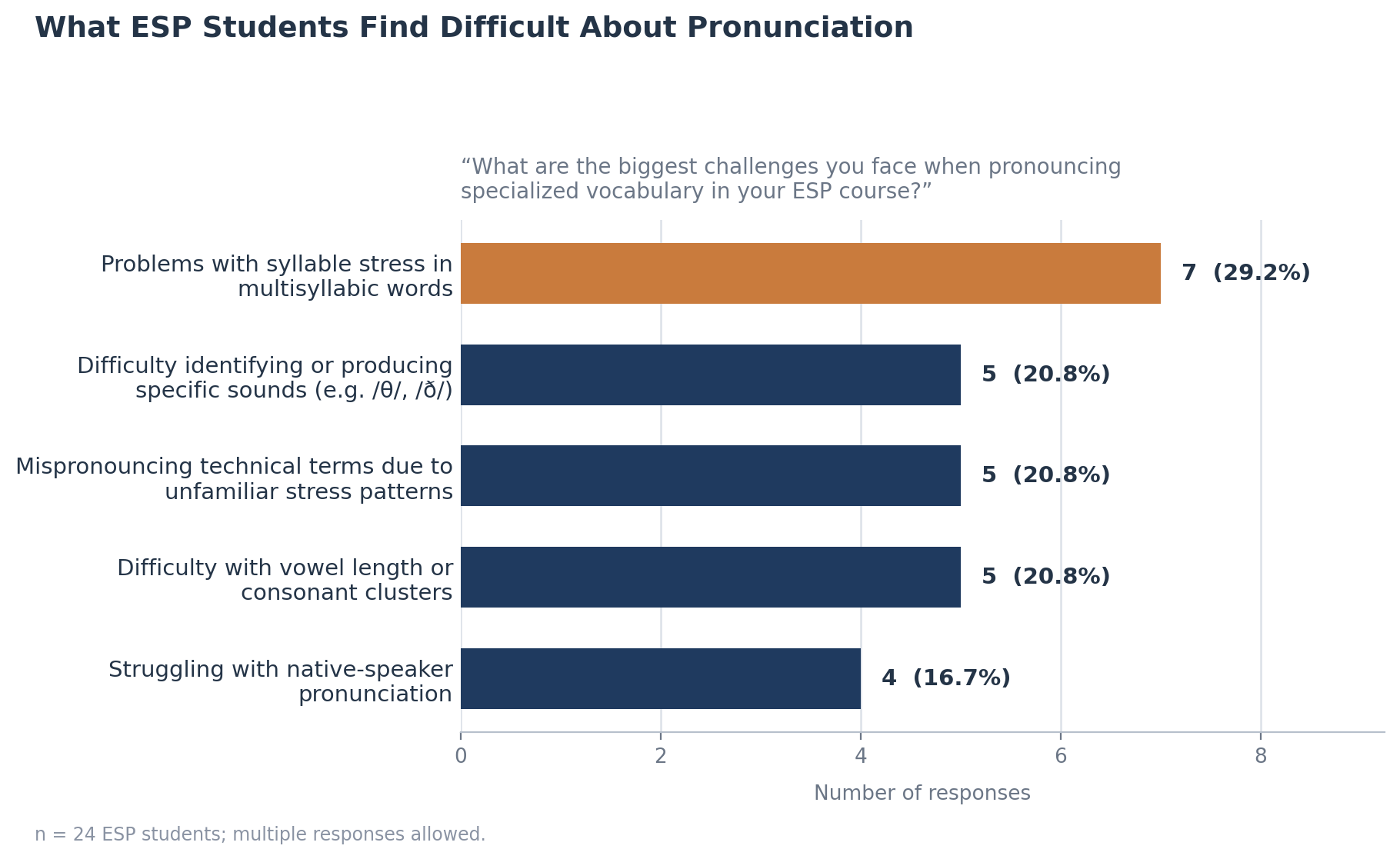
Responses from 24 ESP students; multiple responses were possible.
These answers were not particularly surprising to me as a former Phonetics and Phonology teacher.
What surprised me more was how clearly pronunciation was connected to the specialised vocabulary students were learning.
A technical word is not only something a student has to recognise on a page.
At some point, they may need to say it in a presentation, discuss it with a colleague, ask a question in a professional setting or communicate with someone who already knows the field.
Knowing what a word means is therefore only part of knowing the word.
Pronunciation in ESL – Why It Should Be Top Priority
What students said they needed
The questionnaire also asked students what they thought would help them improve their pronunciation.
Their answers were practical rather than theoretical.
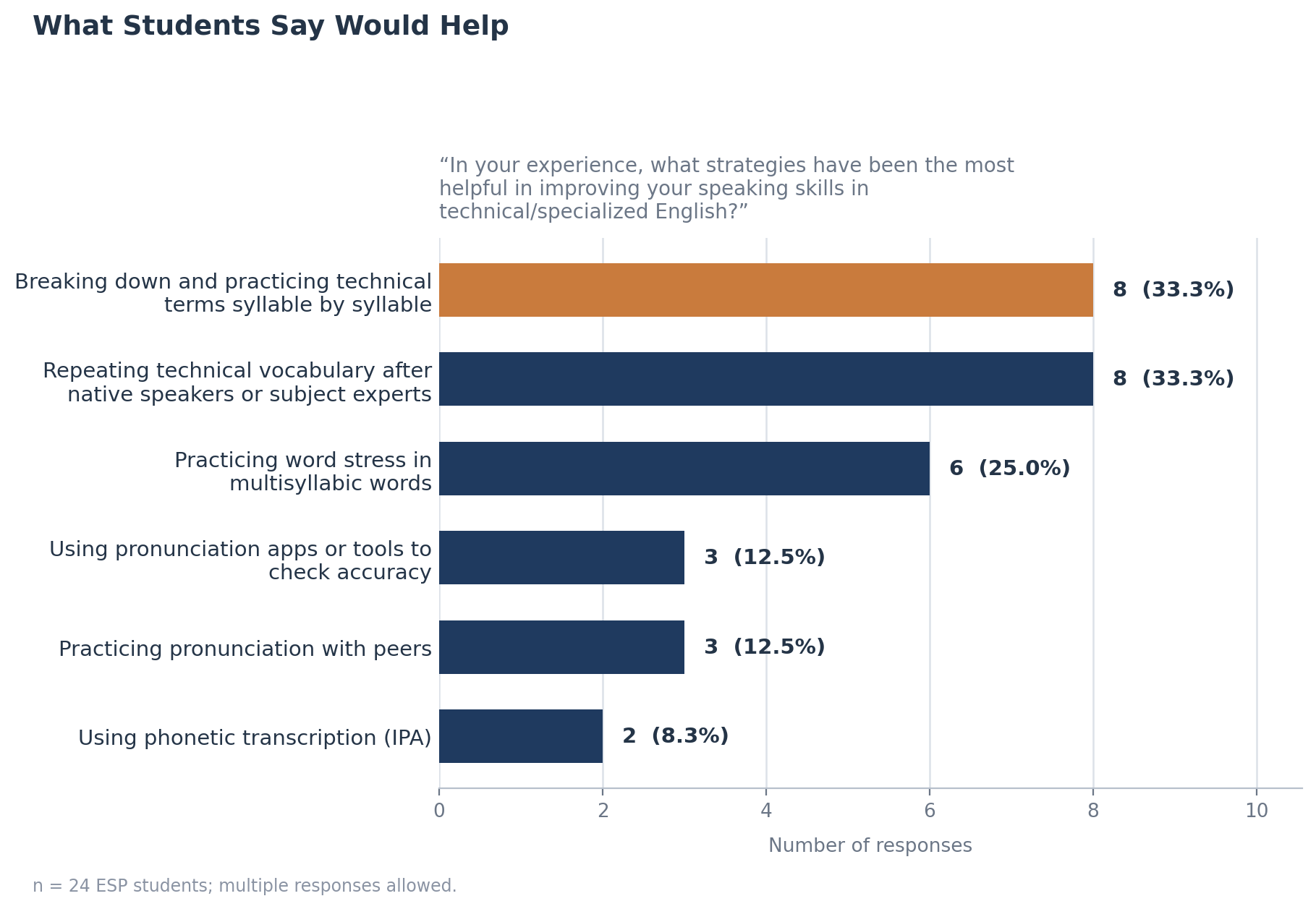
Responses from 24 ESP students.
They suggested breaking technical terms into syllables, repeating words after native speakers or subject experts, practising word stress, recording themselves, using the International Phonetic Alphabet, using pronunciation applications and having more opportunities for speaking practice.
I found this particularly interesting because these are not complicated interventions.
They do not require an ESP teacher to turn a biotechnology lesson into a phonetics lesson.
They simply require us to make some room for pronunciation.
Perhaps this is where the idea of ESP needs to be interpreted carefully.
Teaching English for a particular discipline does not mean that pronunciation suddenly becomes less important because vocabulary and content have become more important.
If anything, specialised vocabulary can create additional pronunciation challenges because students are encountering words that may be unfamiliar both in meaning and in sound.
A student may know exactly what a particular scientific term means and still hesitate when asked to say it.
Pronunciation – IELTS Speaking
The teacher I used to be is still there
There is also something personal in this for me.
After years of teaching Phonetics and Phonology, I sometimes thought of that part of my teaching career as something that belonged to the past.
My work had moved towards ESP, and I had become increasingly interested in how students use English to access their specialist subjects.
But when I looked at these responses, I realised that the Phonetics and Phonology teacher in me had never really disappeared.
I still listen.
And, I still notice stress.
I still hear sounds that students find difficult.
The difference is that I now hear them in a biotechnology classroom, a food science classroom or another ESP context rather than in a course devoted specifically to pronunciation.
Perhaps I did not leave Phonetics and Phonology behind.
I simply stopped teaching it as the main subject.
Making room rather than making it the focus
This experience has made me reconsider what pronunciation needs to look like in an ESP classroom.
I do not think every lesson needs a pronunciation component, nor do I think ESP teachers need to become specialists in phonetics.
But I do think there is value in occasionally stopping over a technical term and asking students not only “What does this word mean?”, but also:
“How do we say it?”
- We can mark the stressed syllable.
- We can break a long word into smaller parts.
- We can listen to the word before asking students to produce it.
- We can let students record themselves and listen back.
- We can compare pronunciation with a dictionary or pronunciation tool.
- And, perhaps most importantly, we can give students opportunities to say technical vocabulary aloud before they are expected to use it confidently in a professional context.
The questionnaire did not give me a definitive answer about pronunciation in ESP.
Twenty-four responses cannot do that.
What it did give me was something I perhaps needed more than another set of statistics: a reason to listen to my students differently.
Their answers reminded me that language does not disappear behind specialised content.
Students may come to an ESP classroom because they want to become biotechnologists, food scientists, agricultural professionals, lawyers or specialists in another field. They may be deeply interested in their subject and highly motivated to learn it.
But when they have to communicate that knowledge in English, the language itself can still become a source of difficulty.
Sometimes that difficulty is vocabulary.
Sometimes it is grammar.
And sometimes it is simply being able to say the word.
For me, making room for pronunciation in ESP does not mean going back to the classroom I used to teach. It means bringing something from that classroom with me.
And perhaps that is what teachers do throughout their careers.
We change subjects, institutions, students and approaches, but parts of our earlier teaching lives remain with us.
Sometimes we only notice them when our students remind us that they are still needed.
Can AI Help Lower-Level Students Prepare for IELTS?
Subscribe to the EFL Magazine Newsletter