Duncan Foord on Nearly 40 Years in TEFL
The Oxford TEFL director on CELTA versus Trinity, learning to teach by doing, and why connection still beats AI in the classroom
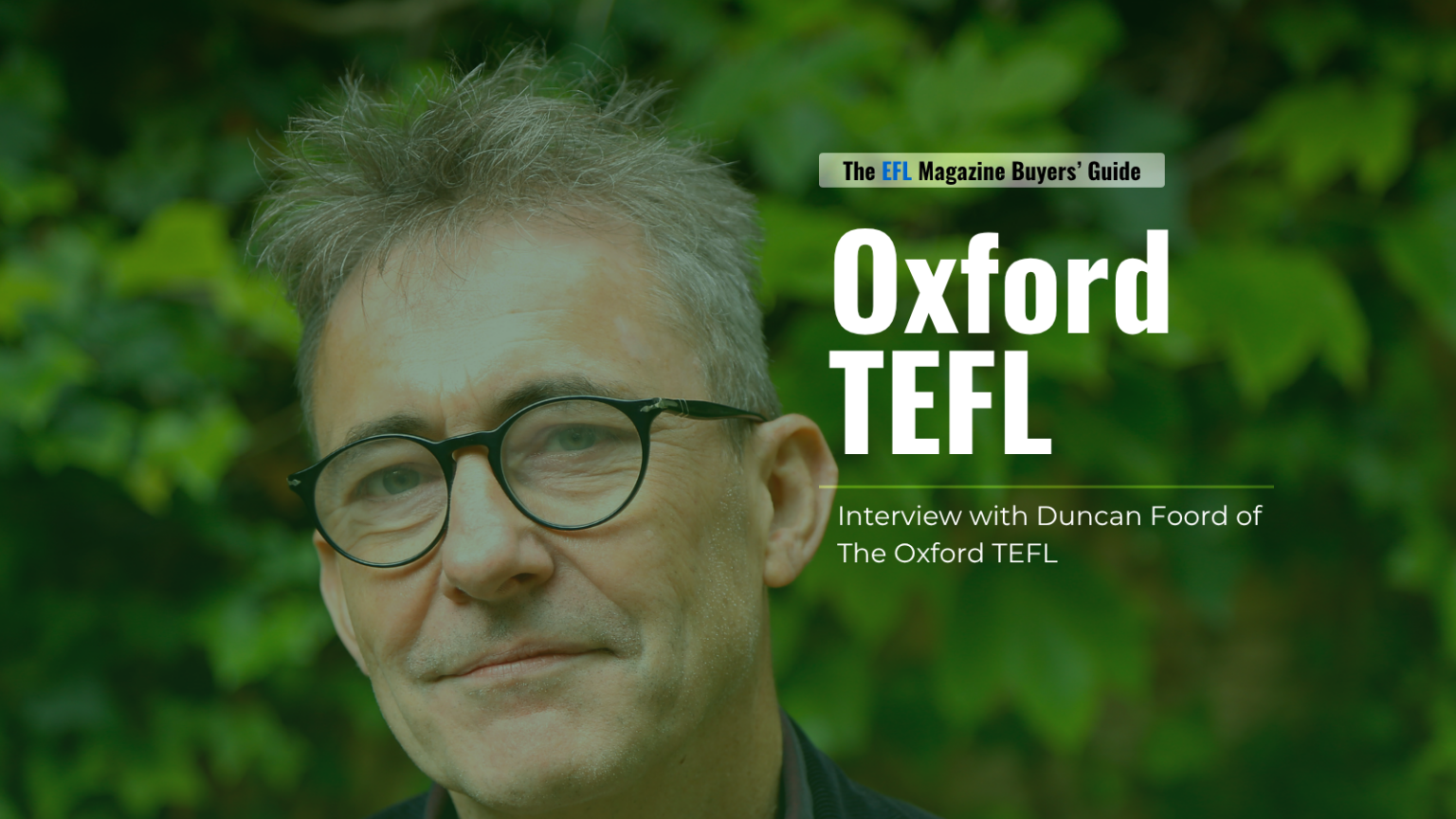
Duncan Ford has been on the TEFL scene since the mid-1980s and now directs Oxford TEFL, the Barcelona-based teacher-training company he helped found in 1998. He spoke with EFL Magazine’s Philip Pound for its podcast series on travel-abroad programs about the difference between a TEFL certificate and a qualification like CELTA, what actually happens during a training course, and what he believes still matters most in a classroom that increasingly includes AI. The conversation, edited and condensed for clarity, follows.
Background
Q: Tell me a bit about Oxford TEFL and how it got started.
A: I was working in Spain from about 1995, running teacher-training programmes and working as a director of studies for other schools. A couple of us decided to go it alone and start our own company, with some backers in the UK who believed in the project. We founded it in 1998, so we’re 26 years old now. Teacher training was always the driving force behind it — unlike most places, which were language schools first and teacher training second, we set out as a teacher-training school from day one, originally running the Trinity CertTESOL and now the Cambridge CELTA. We opened a centre in Prague in 2002, developed our Trinity diploma course for teachers with two or more years of experience, and we also run a language school in Barcelona, Oxford House, teaching English and Spanish.

TEFL, CELTA, or Trinity?
Q: What’s the difference between a general TEFL course and CELTA or Trinity, and where should someone who wants to teach in a market like Spain start?
A: If you’re going to teach in Western Europe or another advanced ELT market, you want a recognised qualification. There are two: the Cambridge CELTA, the Certificate in English Language Teaching to Adults, which has been around 50 or 60 years, and the Trinity CertTESOL. Both are UK-based, both are recognised at Level 7 in the UK, and both are taken seriously across the profession because they’re externally moderated — an outside examiner visits the course and checks the quality and the standards each provider has to meet, from tutor qualifications to how the course is delivered.
There are plenty of TEFL courses out there that may be very good, but who decides that? They do, and their customers do. With CELTA and Trinity you get an uplift in quality on average, and importantly, a qualification that’s accepted wherever you go — in some cases the only one accepted if you need a visa to work in certain countries.
Reflections on My Experience of the CELTA Course
Q: CELTA stands for teaching English to adults. Is it well suited to teaching children?
A: Both CELTA and Trinity are focused on adults because that’s who you practise teaching on during the course — for practical and ethical reasons, you’re not going to be practising on children early on. So you come out of the course, which runs around 150 hours over anywhere from 4 to 24 weeks with a minimum of 6 hours of observed teaching, trained to teach adults. What most providers do, and what we do, is add an option to cover some young-learner theory as well, though not with actual young learners in the room.
CELTA gets you your first job; if you work for a good school, they’ll support you in teaching young learners from there. There isn’t really an initial qualification that says ‘I only want to teach kids’ — it doesn’t work that way. About 80 to 90 percent of what you learn on the course applies to any age group anyway, since it’s about how people learn and how you motivate and organise a class. The kid- or teenager-specific experience comes later, on the job.
Teaching English in Italy: What You Need to Know Before Starting
Q: Some people are intimidated by how intensive a CELTA course sounds. What would you say to them?
A: First of all, that’s actually a good instinct — teaching isn’t easy, and the intensive version of the course isn’t easy either. There’s a real sense of a boot camp, and you need to be committed. It’s a lot of fun and really satisfying, but it’s right to understand what you’re letting yourself in for. That’s why most courses, including ours, require a detailed application form and a 30-minute interview with a tutor or staff member before you’re admitted — it helps you understand the challenges and ask questions so you can make an informed decision. Once people are admitted, our pass rate is about 95 percent or higher, so I think our filtering process works well. That’s not to say people pass without some sweat, blood and tears along the way. You’re in front of students, maybe for the first time — it’s bound to be a little stressful.
Harrison Fowler on Founding RVF International
How the course actually runs
Q: Can you walk through the training process — how it starts, how it’s assessed?
A: The part that can surprise people is that we throw you in at the deep end. On day one you observe an experienced teacher, probably your tutor, teaching the group of students you’ll be teaching. On day two, you’re teaching them yourself. There’s no separate block of theory before you start practising — you learn by doing. You start with short slots, maybe 15 or 20 minutes, and build up to a full hour over the 4 or 5 weeks. You’re in a group of 3 to 6 trainees, taking turns to teach while a tutor observes, and afterwards you gather to discuss how it went and what to improve.
Recommended TEFL Courses
The TEFL Institute of Ireland
Gain internationally recognised TEFL certification, practical teaching skills, expert support, and the confidence to start your teaching journey anywhere.
Premier TEFL

Get qualified with flexible TEFL training, practical resources, expert guidance, and the confidence to teach English and explore opportunities worldwide.
The TEFL Institute
Get TEFL certified, gain practical teaching skills, and turn your qualification into opportunities to teach, travel, work, and experience life abroad.
Oxford Seminars

Turn your dream of teaching abroad into reality with practical training, and the confidence to begin your international adventure.
Alongside that we cover the things you need to know — grammar, since most people have never had to explain English grammar to someone else even if they speak it fluently, pronunciation, classroom management, teaching the different skills, materials, and technology. Assessment has five parts, but the main one is the teaching practice itself, assessed throughout the course, plus some written work — profiling a student, creating materials, writing about grammar and language. There’s no old-fashioned sit-down exam.
DELTA Module 1: a Survival Guide
A story that stuck with him
Q: Do you have a memorable success story from someone who’s taken the course?
A: One that stands out for me isn’t an individual story so much as a project. We collaborated on a school in Kerala, in southern India, about 10 to 15 years ago. There were real social taboos around women taking the course — on the first day of our first course there, a woman told us she was dropping out because her husband didn’t want her in a class with male students and male tutors. That wasn’t a success story for her, but it drove us to keep going, and that school has since flourished.
They now train at least 100 to 150 people a year, many of them women, and their lives — and their students’ lives — have changed because of it. That felt transformational on a bigger level than any single graduate story. On an individual level, there are thousands of people over 25 years who’ve changed their lives through the course, gone off to travel the world and, in a sense, become somebody else. It’s a bit like emigrating — you don’t end up where you started.
Support after the course
Q: How does job support and placement work once someone finishes?
A: We have a careers officer, Diana, who works with a large database of schools in Spain and around the world. If a trainee says they want to work in Japan, she’ll have some knowledge of schools there and can advise them. We also run a Facebook page, Oxford TEFL Jobs, where schools advertise directly — open to our graduates and anyone else. During the course, Diana helps people put together a CV that sells them well, advises on which part of the world might suit them and what the job market and living conditions are actually like there, since it’s impossible for any one trainee to know everything about every country.
And with a large pool of graduates around the world, we can often connect someone to somebody already living where they want to go. That support doesn’t expire — people come back to us years later wanting to change jobs, or to take the Trinity diploma as a next step once they’ve decided to stay in the profession.
Phil Wade Interviews: Daniel Barber
Advice, technology, and what still matters
Q: What advice would you give someone considering teaching English abroad for the first time?
A: It depends a bit on their reasons, but once you’ve made the decision, give it a go — what’s the worst that can happen? It’s going to be a great experience. Not everyone sticks with it forever; plenty of people teach for a year or five and then move on to something else, and that’s fine too. Enjoy the adventure, be open and patient, be prepared to suffer a little — living in another country is tough, and teaching is tough — but it’s tremendously rewarding. It can change your identity, or at least develop it. You learn another language, learn to live in another culture, and find out things about yourself you wouldn’t otherwise.
Q: How has technology changed teaching over the past decade?
A: The real turning point was COVID, about five years ago — online teaching, the Zoom class, became normal. Before that, teaching was essentially 100 percent face-to-face. Now a lot of teachers have at least part of their timetable online, and the majority of our own CELTA trainees now take the course entirely on Zoom — about two-thirds of our total trainees each year. As for AI, we don’t yet know exactly where that goes, but it’s pushing teachers to think about what value they add beyond what a machine can automate. That said, gap-fill exercises, apps and games have been part of language learning for a long time already. Walk into an actual classroom in Tokyo or Barcelona today and I don’t think you’d see anything dramatically different from 10 or 20 years ago — the technology might look a bit newer, but the core of it is similar.
The EFL Magazine Guide: Ten TEFL Online Courses
Q: What’s the most underrated skill for a TEFL teacher?
A: The human element — the ability to understand other human beings. The teacher as therapist and coach, in a sense. As far as I can tell, it’s barely rated at all compared with procedural accuracy and subject knowledge, which obviously matter too. But from watching a huge number of classes over a long career, the connection between teacher and student is what keeps students coming back — it’s arguably the main reason they come at all. That can be trained; it’s not just natural charisma. And I think it’s only going to matter more as AI takes on more of the knowledge-delivery side of teaching. Machines know things. What they can’t easily do is connect, and that’s where teachers need to focus.
Getting started
Q: For anyone whose appetite you’ve whetted for teaching abroad, what’s the first step?
A: Go to OxfordTEFL.com — everything’s there: information about the courses, how to apply, how to get in touch with questions. You can go through the whole application and interview process without paying anything, which is itself a useful way to find out whether it’s really for you.
Subscribe to the EFL Magazine Newsletter